Medical Summary
Heart risk is the single biggest reason British men say they would not try testosterone treatment. In a survey of 973 UK men, 69 per cent named cardiovascular risk as a factor that would deter them, and 67 per cent named the blood becoming thicker [1]. Those are not irrational concerns. They reflect a decade in which regulators warned about heart attacks and strokes, and in which the evidence genuinely was unsettled.
MYTRT treatment eligibility
MYTRT treats men only when they have compatible symptoms and meet both biochemical limits: total testosterone of 15 nmol/L or below, and free testosterone of 0.35 nmol/L or below.
The picture has changed, though not into a clean bill of health. A trial of 5,246 men with existing or high cardiovascular risk found testosterone treatment was no worse than placebo for heart attacks, strokes and cardiovascular death [2]. On the strength of that, the American regulator removed cardiovascular language from the boxed warning in February 2025. In the same decision it added a warning about raised blood pressure across every testosterone product on the market [3]. Both halves are true and we report both.
There is a second thread that is easy to confuse with the first. Men with naturally low testosterone have higher rates of cardiovascular death, shown clearly in a UK cohort of 11,606 men recruited through Norfolk general practices [4]. That is an association, and the researchers themselves described low testosterone as a predictive marker rather than a cause. It does not demonstrate that taking testosterone protects the heart, and no trial has shown that. Anyone presenting it as though it does is misreading the evidence, and in clinic we are careful not to.
Where the fear came from
The concern was not invented by the internet. In January 2014 the US Food and Drug Administration issued a safety communication warning of possible stroke, heart attack and death associated with testosterone products. A joint advisory committee met in September 2014 following those reports, and the outcome was an industry-wide requirement to run a proper trial. In March 2015 the regulator required labelling changes and urged caution about prescribing for age-related low testosterone [3].
What existed at that point were observational studies and small trials pointing in conflicting directions, which is a poor basis for either reassurance or alarm. The honest position throughout that decade was that nobody knew. The trial that the 2014 committee set in motion is the reason we can now say something more definite.
The TRAVERSE trial, in full
TRAVERSE was published in the New England Journal of Medicine in 2023. It matters because of who was studied: not healthy volunteers, but 5,246 men aged 45 to 80 who either already had cardiovascular disease or were at high risk of it, who reported symptoms of hypogonadism, and who had two separate fasting testosterone results below 300 ng/dL, roughly 10.4 nmol/L [2]. If testosterone were dangerous to the heart, this is the group in whom it would show.
| Element | Detail |
|---|---|
| Design | Multicentre, randomised, double-blind, placebo-controlled non-inferiority trial |
| Participants | 5,246 men aged 45 to 80 with existing or high cardiovascular risk |
| Treatment | Daily transdermal 1.62 per cent testosterone gel against placebo gel |
| Duration | Mean 21.7 months of treatment, mean 33.0 months of follow-up |
| Main result | 182 events (7.0 per cent) on testosterone against 190 (7.3 per cent) on placebo |
| Hazard ratio | 0.96, 95 per cent confidence interval 0.78 to 1.17 |
The primary measure combined cardiovascular death, non-fatal heart attack and non-fatal stroke. The rates were near identical [2]. Two points about interpretation deserve emphasis. First, this was a non-inferiority trial, designed to test whether testosterone is not worse than placebo. It was never designed to show benefit, and it did not show benefit. Second, the trial was funded by a manufacturer of testosterone products, which we mention for transparency, with the mitigating context that it was conducted because a regulator required it.
The trial also found three things more often in the men receiving testosterone: atrial fibrillation, acute kidney injury and pulmonary embolism [2]. Those findings were reported in the same paper as the reassuring headline, and any summary that omits them is not giving you the trial. Atrial fibrillation is an irregular heart rhythm that carries its own stroke risk. Pulmonary embolism is a clot in the lung. Neither is common, but both are reasons that treatment belongs under medical supervision rather than bought from an unregulated source.
What changed on the label in 2025
On 28 February 2025 the FDA announced class-wide labelling changes to testosterone products, driven by the trial results and by separately required blood pressure monitoring studies [3]. Three things happened at once, and they pull in different directions.
The cardiovascular language was removed from the boxed warning, the most serious category of warning a medicine can carry. The trial results were added to the labels. The existing limitation on use for age-related low testosterone was retained, meaning the regulator continues to restrict approval to men who have low testosterone alongside an associated medical condition, rather than as a general remedy for ageing [3].
At the same time a new warning was required about increased blood pressure. The regulator’s wording is unambiguous: the completed monitoring studies confirmed an increase in blood pressure with the use of all testosterone products, class-wide [3]. That is why blood pressure is checked before treatment and monitored during it. A man with poorly controlled hypertension needs that addressed as part of his care, not treated as an afterthought.
One caveat on jurisdiction. The FDA regulates medicines in the United States. UK prescribing is governed by the MHRA, with the summary of product characteristics for each preparation and the British National Formulary as the operative documents. The evidence base is shared, but always take the UK labelling for the specific product as authoritative.
Low testosterone and cardiovascular risk: association, not proof
The best UK evidence on this comes from EPIC-Norfolk, which recruited 11,606 men aged 40 to 79 from the age-sex registers of general practices in Norfolk and followed them from the mid-1990s [4]. Comparing 825 men who died against 1,489 matched controls, the men in the highest quartile of testosterone had roughly half the odds of cardiovascular death compared with those in the lowest, with a clear gradient across quartiles. An increase of 6 nmol/L was associated with an odds ratio of 0.81 for death from any cause [4].
Those figures survived adjustment for a long list of confounders including body mass index, waist-hip ratio, blood pressure, cholesterol, smoking, physical activity, alcohol, diabetes and social class. That thoroughness makes the association credible. It does not make it causal, and the authors were careful on this point, describing low testosterone as possibly a predictive marker for men at high cardiovascular risk [4].
The distinction is not academic. Low testosterone travels with obesity, type 2 diabetes, poor sleep and inactivity, all of which independently damage the cardiovascular system. A low reading may be a signal of metabolic trouble rather than the cause of it. That is a reason to take a low result seriously as a prompt to look at the whole picture, and it is not a reason to expect a prescription to fix the heart. Our page on benefits of testosterone sets out what treatment has and has not been shown to achieve.
Thicker blood, and why it is monitored
Two-thirds of the men in that UK survey named blood thickening as a deterrent, and unlike some worries this one has a clear mechanism [1]. Testosterone stimulates the production of red blood cells; British guidance notes that it promotes erythropoiesis in the kidneys [5]. If the proportion of red cells in the blood climbs too high, the blood becomes more viscous, and that is relevant to clot risk.
This is why a full blood count is part of baseline testing and of ongoing monitoring, and why a rising haematocrit leads to a change in dose, a change in preparation or a pause in treatment rather than being noted and ignored. It is a manageable risk under supervision and an unmanaged one otherwise, which is the practical argument against sourcing testosterone outside a regulated pathway. The pulmonary embolism signal in TRAVERSE sits alongside this mechanism and reinforces why the monitoring is not a formality. We cover the full monitoring picture in TRT side effects.
Where cardiovascular disease and testosterone deficiency meet
British Society for Sexual Medicine guidance lists a number of cardiovascular conditions in which testosterone deficiency is more prevalent, including atrial fibrillation, hypertension, coronary artery disease, cerebrovascular disease and chronic heart failure [5]. Low testosterone is also associated with a higher risk of developing type 2 diabetes and with increased all-cause mortality [5].
The same guidance describes testosterone’s direct actions on the cardiovascular system: it affects cardiac output and both coronary and peripheral blood flow, shortens the QTc interval and reduces reperfusion injury [5]. This is a hormone with real cardiovascular activity, which cuts both ways. It is a reason the safety question was worth asking properly, and a reason that men with established heart disease should be assessed by a clinician who has their cardiac history in front of them.
There is also a point about who gets assessed at all. British guidance notes that around 75 per cent of men maintain normal testosterone into old age, so deficiency is not an inevitable consequence of getting older [5]. Deficiency is diagnosed on symptoms together with biochemistry, confirmed on two separate tests, not on a single number in isolation.
The metabolic route, which is where most of the risk sits
If there is a mechanism connecting testosterone and the heart that matters for most men, it runs through metabolism rather than directly through the heart muscle. Low testosterone is associated with an increased risk of developing type 2 diabetes, and diabetes is among the strongest drivers of cardiovascular disease there is [5]. The relationship works in both directions: excess weight lowers testosterone, and low testosterone makes it harder to shift weight and maintain muscle.
The UK cohort data illustrate how tightly these things travel together. Men in the lowest quartile of testosterone had a mean body mass index of 27.7 and a diabetes prevalence of 7.9 per cent, and 43.6 per cent were physically inactive. In the highest quartile the same figures were 25.7, 1.9 per cent and 24.1 per cent [4]. Those are substantial differences in exactly the variables that determine cardiovascular outcomes.
This is why a serious consultation covers weight, activity, alcohol, sleep and existing diagnoses rather than dwelling only on the hormone result. Where a man’s central problem is metabolic, the interventions with the strongest cardiovascular evidence are the unglamorous ones. Treatment may still be appropriate alongside them, but presenting a prescription as a substitute for addressing metabolic health would be doing him a disservice. Our page on how to increase testosterone covers the lifestyle side in more depth.
Why unregulated supply is the real cardiovascular risk
Almost everything described on this page depends on supervision. The blood pressure warning matters because blood pressure is being measured. The clotting and rhythm signals from TRAVERSE matter because someone is asking about your history before you start and is reachable if something changes. The thickening of the blood is manageable because a full blood count is being repeated at intervals and acted upon.
Remove the supervision and none of those safeguards exist, while the physiological effects remain exactly the same. Testosterone obtained through an unregulated channel arrives without baseline testing, without dose adjustment, without monitoring and without anyone to tell. Doses used outside medical supervision also tend to be considerably higher than replacement doses, which is the context in which cardiovascular harm is most plausible. That is a materially different proposition from the treatment studied in TRAVERSE.
The regulatory framing supports this reading. Testosterone is approved for men who have low testosterone alongside an associated medical condition, not as a general enhancement [3]. That limitation was deliberately retained in 2025 even as the cardiovascular warning was removed. If you want to understand how a properly governed pathway differs, TRT in the UK sets out what regulated care involves.
The questions worth asking before you start
If you have any cardiovascular history, these are the things a clinician should be discussing with you, and the things you are entitled to ask about.
- Your blood pressure before treatment, and how often it will be rechecked, given the class-wide warning on raised blood pressure
- Your baseline haematocrit and full blood count, and the plan if it rises
- Any history of atrial fibrillation, clots in the leg or lung, or kidney problems, given the signals seen in TRAVERSE
- Whether your low reading might be driven by something reversible such as untreated sleep apnoea, weight or medication
- What the realistic expectations are, and specifically that treatment is not a cardiovascular preventive
- Who is prescribing, who is monitoring and how you contact them if something changes
On the fourth of those, sleep is a common and frequently missed contributor. Our page on testosterone and sleep apnoea explains why untreated apnoea can both suppress testosterone and complicate treatment.
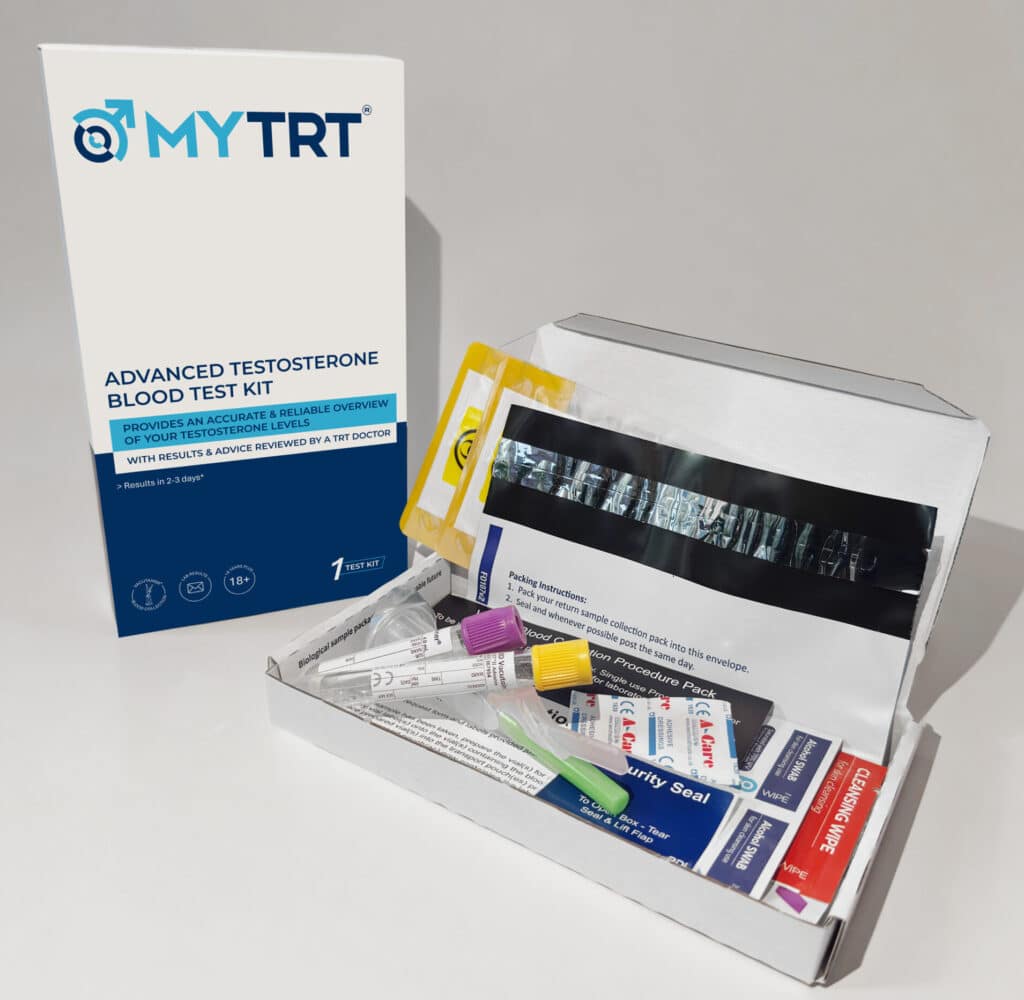
Advanced Testosterone Blood Test
Book a venous draw at a clinic £99.49
Book a venous draw at home with a nurse £109.49
 General health check
How we approach cardiovascular risk at MYTRT
Cardiovascular history is part of the initial consultation, not a box ticked at the end. We ask about diagnosed heart conditions, blood pressure, clotting history, family history and current medication. Blood pressure and a full blood count form part of baseline testing, and both are repeated as part of ongoing monitoring alongside hormone levels.
Where a man’s cardiovascular position needs input beyond what a treatment service should be deciding, the right answer is a referral rather than a prescription, and we can arrange a private GP appointment through our sister service or refer into NHS care. Where treatment does proceed, prescribing and final dosing decisions rest with the prescribing clinicians and our regulated pharmacy partner, and we review at regular intervals with quarterly blood tests so that changes are picked up while they are still small.
We are not going to tell you that testosterone will protect your heart, because the evidence does not support that claim. What the evidence now supports is that, in men with genuine deficiency and appropriate monitoring, treatment did not increase major cardiac events in the population most at risk. That is a meaningful reassurance, and it is a different statement from a promise. If you want the wider safety picture, is TRT safe covers it, and normal testosterone levels explains how results are interpreted.
References
- Liu VN, et al. Awareness and prevalence of the symptoms of testosterone deficiency among community-dwelling men in the UK: a cross-sectional survey. BMJ Open 2025;15(7):e094145. View
- Lincoff AM, Bhasin S, Flevaris P, et al. Cardiovascular Safety of Testosterone-Replacement Therapy. New England Journal of Medicine 2023;389(2):107-117. View
- US Food and Drug Administration. FDA issues class-wide labeling changes for testosterone products, 28 February 2025. View
- Khaw KT, Dowsett M, Folkerd E, et al. Endogenous testosterone and mortality due to all causes, cardiovascular disease, and cancer in men: European Prospective Investigation Into Cancer in Norfolk (EPIC-Norfolk) Prospective Population Study. Circulation 2007;116(23):2694-2701. View
- Hackett G, Kirby M, Rees RW, et al. The British Society for Sexual Medicine Guidelines on Male Adult Testosterone Deficiency, with Statements for Practice. World Journal of Men’s Health 2023;41(3):508-537. View