Medical Summary
Testosterone is the primary male sex hormone, essential for the development of male reproductive tissues, the maintenance of muscle mass and bone density, and the regulation of libido, mood, and energy levels. In clinical practice, “normal” testosterone levels are defined by population reference ranges, but these ranges are broad and must be interpreted in the context of an individual’s age, symptoms, and overall health. In the UK, total testosterone is measured in nanomoles per litre (nmol/L). The widely accepted normal range for adult men is approximately 10 to 35 nmol/L, though this varies slightly between laboratories. The British Society for Sexual Medicine (BSSM) guidelines state that a total testosterone level consistently below 12 nmol/L, accompanied by relevant symptoms, warrants clinical investigation and potential treatment.[1]
Testosterone levels follow a well-documented trajectory across a man’s lifespan. They peak during late adolescence and early adulthood, then begin a gradual decline of approximately 1–2% per year from the age of 30 onwards. This age-related decline means that what is considered a “normal” level for a 25-year-old may differ significantly from that of a 65-year-old. However, a decline that results in symptomatic hypogonadism is not an inevitable consequence of ageing; it is often exacerbated by modifiable lifestyle factors such as obesity, chronic stress, poor sleep, and underlying metabolic conditions. Accurate diagnosis requires two separate morning blood samples, as testosterone levels fluctuate throughout the day, peaking in the early morning.
Understanding the Testosterone Normal Range
When patients ask us, “What is a normal testosterone level?”, the answer is rarely a single number. The concept of a “normal range” in endocrinology is derived from statistical analysis of a healthy population. It represents the central 95% of values found in men without known endocrine disease. In the UK, NHS and private laboratories typically report the normal range for total testosterone in adult men as approximately 10 to 35 nmol/L. However, this broad range encompasses a vast spectrum of physiological states.
A man with a total testosterone of 11 nmol/L is technically within the normal range, yet he may experience profound symptoms of deficiency if his personal baseline was previously 25 nmol/L. Conversely, another man may function perfectly well at 13 nmol/L. This is why clinical guidelines, including those from the BSSM and NICE, emphasise that biochemical results must always be interpreted alongside a detailed clinical history.[2] We do not treat numbers; we treat patients.
It is also crucial to distinguish between total testosterone and free (or bioavailable) testosterone. Total testosterone measures all the hormone present in the blood. However, approximately 98% of this is bound to proteins — primarily sex hormone-binding globulin (SHBG) and albumin — rendering it biologically inactive. Only the remaining 1–2%, known as free testosterone, is available to enter cells and exert its effects. As men age, SHBG levels tend to rise, meaning that even if total testosterone remains stable, the amount of free, active testosterone may decline significantly. A comprehensive assessment must therefore include SHBG to calculate free testosterone accurately.
The BSSM Guidelines on Normal Levels
The British Society for Sexual Medicine provides clear thresholds for clinical decision-making in the UK:
- Total Testosterone > 12 nmol/L: Generally considered normal. Testosterone replacement therapy (TRT) is not typically indicated unless free testosterone is demonstrably low (e.g., due to elevated SHBG).
- Total Testosterone 8–12 nmol/L: A borderline or “grey” area. Men in this range may benefit from a trial of TRT if they have significant symptoms of hypogonadism and other causes have been excluded. Free testosterone calculation is essential here.
- Total Testosterone < 8 nmol/L: Clearly deficient. TRT is strongly recommended, assuming no contraindications, to alleviate symptoms and protect long-term health (e.g., bone density).
For context, US guidelines from the Endocrine Society often cite a lower threshold of 300 ng/dL (approximately 10.4 nmol/L) for diagnosing hypogonadism, though they acknowledge the importance of free testosterone in borderline cases.[3] BSSM guidance is described here for clinical context, but it is not MYTRT treatment policy. MYTRT treatment eligibility requires compatible symptoms and both biochemical limits: total testosterone of 15 nmol/L or below and free testosterone of 0.35 nmol/L or below.
The NHS threshold gap: why symptomatic men can still be told they are “normal”
In practice, the NHS commonly regards a total testosterone below 8 nmol/L as clearly low. Clinical evidence, however, shows that symptoms including fatigue, low mood and reduced libido can appear at levels well above that threshold, in some men up to around 15 nmol/L.[1] This creates a gap into which many men fall: genuinely symptomatic, yet not low enough on paper to qualify for NHS investigation or treatment. If your results sit in this range and your symptoms persist, a repeat morning blood test together with a doctor-led review of free testosterone, SHBG and your wider health is the appropriate next step rather than being told your result is “normal” and left without answers.
It is worth noting that a single measurement is rarely sufficient. Testosterone follows a circadian rhythm, peaking in the early morning (typically 07:00–10:00) and falling by as much as 30–35% by the afternoon. This is why BSSM guidance recommends fasting morning blood samples for accurate assessment. A result taken at 15:00 may appear falsely low even in a man with entirely normal gonadal function.
Testosterone Levels by Age: A Detailed Breakdown
Testosterone levels are not static across a man’s lifetime. They follow a well-documented trajectory that peaks in early adulthood and then declines progressively. Understanding this trajectory helps both clinicians and patients interpret results in context. In clinic we see men in their 30s with results that would be unremarkable in a 65-year-old, yet those same numbers represent a meaningful decline from that individual’s personal peak.
Foetal and Early Childhood
Testosterone production begins in the foetus around week 8 of gestation, driven by human chorionic gonadotrophin (hCG) from the placenta. This early surge is responsible for the differentiation of male reproductive structures. A second postnatal surge occurs in the first few months of life — sometimes called “mini-puberty” — during which testosterone levels briefly approach adult concentrations before falling to very low levels for the remainder of childhood.
Puberty (Ages 9–17)
The HPG axis reactivates during puberty, typically between the ages of 9 and 14 in boys. Testosterone rises dramatically over several years, driving the development of secondary sexual characteristics: testicular enlargement, pubic and axillary hair growth, penile development, voice deepening, and the adolescent growth spurt. By mid-to-late puberty, testosterone levels begin approaching adult concentrations, generally reaching 10–20 nmol/L by the late teenage years.
Peak Years: Ages 18–30
Testosterone reaches its lifetime peak during the late teens and twenties. Average total testosterone in healthy men aged 19–30 typically falls between 19 and 30 nmol/L, though individual variation is considerable. Men at the upper end of the range may record levels of 30–35 nmol/L without any pathology. This is the reference decade against which age-related decline is measured.
Ages 30–50: The Gradual Decline
After approximately age 30, total testosterone declines at a rate of around 1–2% per year.[4] This is a population average; some men experience steeper declines, particularly those with obesity, type 2 diabetes, chronic illness, or significant psychological stress. By age 40, a man’s average total testosterone may be 15–25 nmol/L. By age 50, the average sits closer to 13–20 nmol/L. Importantly, SHBG tends to rise with age, meaning that even if total testosterone remains within range, bioavailable testosterone may fall more steeply than the headline number suggests.
Ages 50–70 and Beyond
The decline continues through the sixth and seventh decades. Men aged 60–70 show average total testosterone levels of approximately 11–18 nmol/L in large population studies. By age 70–80, average levels may be 9–14 nmol/L. Late-onset hypogonadism — the clinical syndrome of low testosterone occurring in middle-aged and older men — is estimated to affect 2–5% of men over 40 in Europe, though symptomatic deficiency is substantially under-diagnosed.[5] The following approximate age-band averages are a useful clinical reference:
- 20–29 years: 19–30 nmol/L
- 30–39 years: 16–27 nmol/L
- 40–49 years: 14–23 nmol/L
- 50–59 years: 12–20 nmol/L
- 60–69 years: 10–17 nmol/L
- 70+ years: 8–14 nmol/L
It is crucial to reiterate that these are population medians, not diagnostic thresholds. A 60-year-old man with a level of 11 nmol/L and severe symptoms of hypogonadism may still be a candidate for treatment, despite his level being “average” for his age group.
How the Body Regulates Testosterone
To understand what constitutes a normal testosterone level, it is helpful to understand how the body regulates its production. The process is controlled by the hypothalamic-pituitary-gonadal (HPG) axis, a complex feedback loop involving the brain and the testes.
The hypothalamus, a region in the brain, secretes gonadotrophin-releasing hormone (GnRH) in a pulsatile manner. This stimulates the anterior pituitary gland to release luteinising hormone (LH) and follicle-stimulating hormone (FSH) into the bloodstream. LH travels to the testes, where it binds to receptors on the Leydig cells, stimulating them to produce and secrete testosterone. FSH, meanwhile, acts on the Sertoli cells in the testes to stimulate spermatogenesis (sperm production).
The system operates on a negative feedback loop. When testosterone levels in the blood rise, they signal the hypothalamus and pituitary to reduce the secretion of GnRH and LH, thereby slowing testosterone production. Conversely, when testosterone levels fall, the inhibition is lifted, and GnRH and LH secretion increase to stimulate the testes. This precise regulatory mechanism maintains testosterone within its physiological range under normal circumstances. Learn more about the function of testosterone in the body.
Diagnosing Low Testosterone: The Testing Process
Diagnosing testosterone deficiency is a two-step process: identifying the clinical symptoms and confirming the biochemical deficiency through blood testing. Symptoms alone are non-specific and can overlap with depression, thyroid dysfunction, or simple overwork. Conversely, a low biochemical result in an asymptomatic man does not necessarily warrant treatment.
A standard testosterone panel in UK practice typically includes total testosterone, SHBG (to calculate free testosterone), LH, FSH, prolactin, and often a full blood count and metabolic screen. LH and FSH help distinguish primary hypogonadism (testicular failure, characterised by high LH/FSH) from secondary hypogonadism (pituitary or hypothalamic dysfunction, characterised by low or inappropriately normal LH/FSH). This distinction has direct implications for treatment choice and fertility outcomes. Find out more about what a testosterone test involves.
NHS testosterone testing is available via GP referral, though access varies by region and many GPs remain cautious about initiating testosterone replacement therapy without specialist input. Private testing through services such as MYTRT allows men to obtain a comprehensive hormonal panel quickly, with results interpreted by clinicians experienced in men’s health. Read our guide to getting a testosterone test on the NHS.
Causes of Low Testosterone
Low testosterone (hypogonadism) can arise from pathology at any level of the HPG axis. Primary hypogonadism reflects failure of the testes themselves — causes include Klinefelter syndrome (47,XXY karyotype), orchitis, testicular torsion, chemotherapy or radiotherapy, and surgical orchidectomy. Secondary hypogonadism results from insufficient stimulation of the testes due to pituitary or hypothalamic disease — causes include hyperprolactinaemia, pituitary adenoma, haemochromatosis, Kallmann syndrome, and the suppressive effects of exogenous opioids or anabolic steroids.
Late-onset hypogonadism — the most common form encountered in general men’s health practice — is often multifactorial. Obesity is particularly important: adipose tissue contains aromatase, the enzyme that converts testosterone to ooestradiol, and visceral fat accumulation is strongly associated with lower testosterone levels. Type 2 diabetes, obstructive sleep apnoea, chronic psychological stress, and certain medications (including glucocorticoids, opioids, and some antidepressants) can all suppress testosterone production.[4] In clinic we see a significant number of men in their 40s whose low testosterone is substantially driven by lifestyle factors, and for whom targeted weight loss and sleep optimisation produce meaningful hormonal improvements before any pharmacological intervention is considered.
Treatment Options When Testosterone Levels Are Low
When biochemical hypogonadism is confirmed and symptoms are consistent, testosterone replacement therapy (TRT) is the primary treatment. In the UK, licensed preparations include transdermal gels (Testogel, Tostran), intramuscular injections (Sustanon 250, Nebido), and transdermal patches. Each has distinct pharmacokinetic profiles, practical considerations, and side-effect profiles. The BSSM guidelines provide a detailed framework for initiating, monitoring, and adjusting TRT, with recommended follow-up blood tests at 3 months, 6 months, and annually thereafter once stable.[1]
The treatment target on TRT is generally a mid-normal total testosterone level — typically 15–25 nmol/L — rather than the absolute maximum of the reference range. Supraphysiological levels carry risks including polycythaemia (elevated haematocrit), suppression of endogenous LH and FSH (with consequent impairment of sperm production and testicular atrophy), and potential cardiovascular effects. Men wishing to preserve fertility are typically managed with human chorionic gonadotrophin (hCG) alone or in combination with clomiphene citrate, which stimulates endogenous testosterone production without suppressing the HPG axis.
Lifestyle modification remains an important adjunct to — and sometimes alternative to — TRT. Weight loss of 10% or more body weight in obese men can raise testosterone by 3–5 nmol/L. Resistance exercise, improved sleep quality, alcohol reduction, and stress management all support healthier testosterone levels. These interventions should be actively encouraged regardless of whether pharmacological treatment is initiated.
Testosterone Blood Test Kit
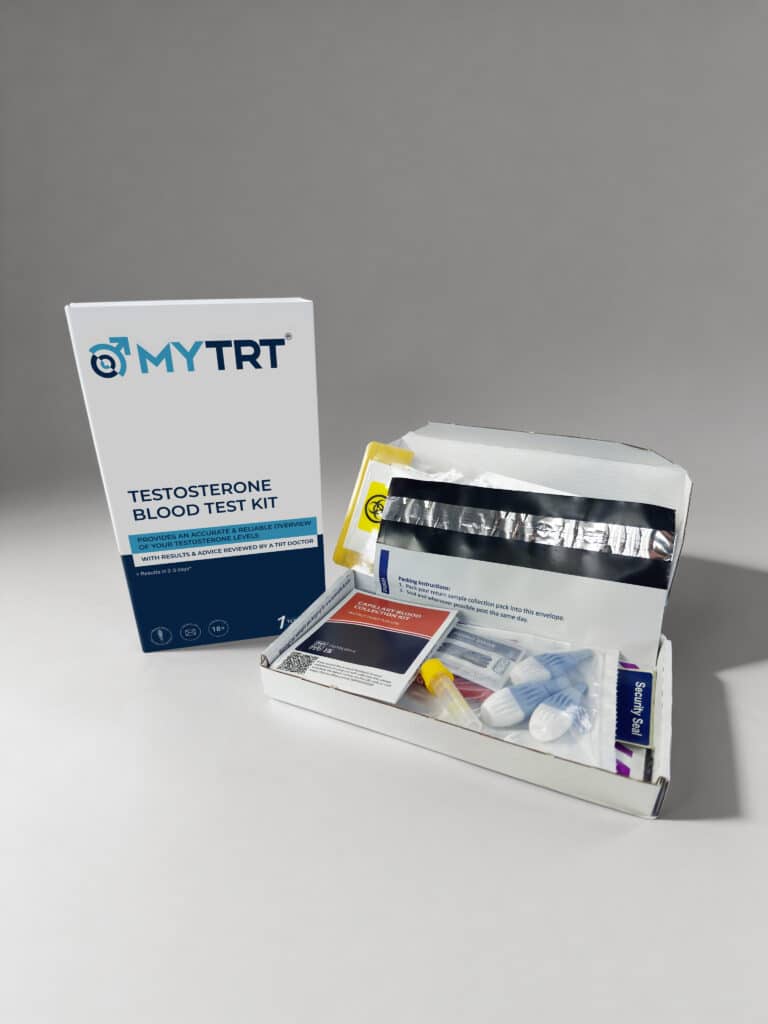
If this test showed you have low testosterone, the Advanced Testosterone Blood Test will assess your suitability for TRT.
References
- [1] NHS. Testosterone test. Available at: View [Accessed May 2025] View ↩
- [1] Hackett G, et al. British Society for Sexual Medicine Guidelines on Adult Testosterone Deficiency, With Statements for UK Practice. Journal of Sexual Medicine. 2017;14(12):1504–1523. Updated guidance available at: View [Accessed May 2025] British Society for Sexual Medicine, Guidelines on Male Adult Testosterone Deficiency, with Statements for Practice (2023) ↩
- [3] Endocrine Society. Testosterone Therapy in Men with Hypogonadism: An Endocrine Society Clinical Practice Guideline. Journal of Clinical Endocrinology & Metabolism. 2018;103(5):1715–1744 View ↩
- [2] Hackett G, Kirby M, Rees RW, et al. The British Society for Sexual Medicine guidelines on male adult testosterone deficiency, with statements for practice. World J Mens Health. 2023;41(3):508–537. Available at: British Society for Sexual Medicine, Guidelines on Male Adult Testosterone Deficiency, with Statements for Practice (2023) ↩
- [5] Bhasin S, et al. Testosterone Therapy in Men with Hypogonadism: An Endocrine Society Clinical Practice Guideline. Journal of Clinical Endocrinology & Metabolism. 2018;103(5):1715–1744 View ↩
- [4] Wu FC, et al. Identification of late-onset hypogonadism in middle-aged and elderly men. New England Journal of Medicine. 2010;363(2):123–135 View ↩
- [5] Corona G, et al. Obesity and late-onset hypogonadism. Molecular and Cellular Endocrinology. 2015;418(Pt 2) View ↩