Medical Summary
Obstructive sleep apnoea and low testosterone share a great deal of ground. Both produce exhaustion that sleep does not fix, both flatten libido and mood, and both are far more common in men carrying excess weight around the middle. In clinic, that overlap matters more than it might appear, because a man who snores heavily and wakes unrefreshed may have a hormonal problem, a breathing problem, or both at once. Treating one while ignoring the other rarely produces the result he came in for.
MYTRT treatment eligibility
MYTRT treats men only when they have compatible symptoms and meet both biochemical limits: total testosterone of 15 nmol/L or below, and free testosterone of 0.35 nmol/L or below.
The clinical order of operations is what this page is really about. Sleep disorders sit among the recognised causes of what specialists call functional hypogonadism, meaning a low reading driven by something else that is potentially reversible rather than a permanent failure of the testicles or pituitary gland [1]. Untreated severe sleep apnoea also gives most clinicians reason to pause before starting testosterone, because there is evidence that it can make disordered breathing worse, at least in the early weeks [2]. Screening for apnoea before treatment, rather than after a problem appears, is the safer sequence.
We want to be straightforward about the limits of the evidence here, because this is an area where confident claims outrun the data. Sleep apnoea is genuinely associated with lower testosterone, and that association survives adjustment for body weight and age. What has not been demonstrated is that treating apnoea with CPAP reliably raises testosterone; the pooled evidence shows no significant effect. Weight loss has better support. Anyone telling you the relationship is simple is overstating what is known.
Why snoring is a clinical question, not a domestic one
Snoring is usually treated as an inconvenience belonging to the bedroom rather than the consulting room. Obstructive sleep apnoea is different. The airway does not merely vibrate, it closes, either partly or completely, and it does so repeatedly through the night. Each closure drops the oxygen level in the blood and pulls the sleeper up into a lighter stage of sleep to reopen the airway. The man himself often remembers none of it. What he notices is that eight hours in bed feels like four.
Clinicians grade severity using the apnoea-hypopnoea index, which counts how many breathing interruptions occur per hour of sleep. Five to fifteen is classed as mild, fifteen to thirty as moderate, and above thirty as severe [2]. Prevalence estimates vary widely with the definition used, but around fifteen per cent of adult men are affected, and among men who are obese the figure approaches half [2]. It is substantially more common in men than in women.
Left untreated, the condition is not benign. It is an independent risk factor for high blood pressure, coronary heart disease, heart failure, arrhythmias including atrial fibrillation, stroke and insulin resistance [1]. That list should be read alongside anything you read about hormones, because it means an apnoea diagnosis is worth having in its own right, quite separately from what it does to testosterone.
The symptoms that belong to both conditions
Here is the difficulty that brings men to us. The recognised symptoms of obstructive sleep apnoea include snoring, waking to pass urine, daytime sleepiness, morning headache, difficulty concentrating, irritability, low mood and reduced libido [2]. Read that list again with low testosterone in mind and you will see the problem: apart from the snoring and the headache, it is very nearly the same list. Our page on low testosterone symptoms sets out the hormonal version in detail.
Because the presentations converge, a symptom questionnaire cannot separate them. Nor can a single blood test, taken in isolation, tell you whether a low reading reflects a primary hormonal problem or the downstream consequence of a year of broken sleep. This is precisely why we ask about sleep, snoring and daytime sleepiness during consultations, and why a partner’s description of what happens at night is often more informative than anything the patient can report himself.
There is one finding worth singling out. Among men with severe apnoea, testosterone level was the only independent predictor of physical fatigue and reduced activity [1]. That does not mean testosterone caused the fatigue, but it does suggest the two problems compound each other rather than simply coexisting.
How disrupted sleep lowers testosterone
Testosterone production is not spread evenly across the day. It follows the sleep cycle. Levels begin to climb as a man falls asleep, reach their peak around the first period of REM sleep roughly eighty to a hundred minutes after sleep onset, and hold there until waking [1]. The hormone is released in response to pulses of luteinising hormone from the pituitary gland, and those pulses depend on sleep continuing undisturbed.
Fragment the sleep and you interrupt the mechanism. Men with obstructive sleep apnoea spend less time in REM and deep sleep, wake more often and have poorer sleep efficiency, and the nocturnal testosterone rise is blunted as a result [1]. The longer it takes to reach REM, the slower the rise. There is also evidence that apnoea acts directly on the pituitary, reducing the amplitude of luteinising hormone pulses and lowering mean levels of that hormone, which produces the pattern clinicians call secondary hypogonadism [2].
The practical implication is about timing as much as biology. Because testosterone depends on a full night of consolidated sleep, a man whose sleep is repeatedly broken may produce a low morning reading that reflects his nights rather than his testicles. That is one of several reasons a single result is never enough on its own, a point we cover in normal testosterone levels.
Is it the apnoea, or is it the weight?
This is the honest argument in the field and it deserves setting out properly rather than being smoothed over. Excess weight causes obstructive sleep apnoea through several routes: fat deposits beneath the jaw and within the tongue and soft palate narrow the airway, and reduced lung volumes lessen the downward traction that helps hold the pharynx open [2]. Excess weight also lowers testosterone independently, because adipose tissue expresses aromatase, the enzyme that converts testosterone into ooestradiol [1].
So obesity could plausibly be the common cause of both, with no direct relationship between them at all. Some analyses support that reading: the association between testosterone and disordered breathing weakens considerably once body mass index or waist circumference is taken into account [3].
Against that, a meta-analysis of eighteen studies covering 1,119 men with apnoea and 704 controls found the inverse relationship between apnoea and testosterone persisted independently of both body mass index and age, and tracked with severity [2]. A separate pooled analysis of twenty-four case-control studies, 1,268 patients against 745 controls, also found significantly lower testosterone in men with apnoea [2]. The fairest summary is that weight is a major shared driver and disordered breathing appears to contribute something of its own on top.
Reversible or permanent: why the distinction decides the treatment
Endocrine practice separates two situations that produce identical blood results. Organic hypogonadism means a permanent structural problem in the hypothalamic-pituitary-testicular axis, and testosterone replacement is the appropriate answer. Functional hypogonadism means the axis is intact but suppressed by something else, and that something else may be treatable, in which case the hormone can recover without replacement [3].
Sleep disorders sit in the second group [3]. That single fact changes the order of the consultation. If a man has undiagnosed moderate or severe apnoea, the correct first step is to get the apnoea assessed and treated, then to reassess his hormones once his sleep has been repaired and any weight change has taken effect. Starting lifelong hormone treatment for a suppressed reading, without asking why it is suppressed, risks committing a man to a therapy he may not have needed.
This is the practical expression of treating the patient rather than the number. It also occasionally means we advise a man that testosterone is not his first problem, which is not what a service optimised purely for conversion would say.
Will treating sleep apnoea raise testosterone?
Not reliably, on the evidence available, and you should be sceptical of anyone who promises otherwise. Continuous positive airway pressure, or CPAP, is the first-choice treatment for moderate to severe apnoea and it is very effective at holding the airway open. Its effect on hormones is a separate question.
A meta-analysis of twelve studies covering 388 men, with follow-up from four to 156 weeks, found CPAP produced no statistically significant change in total testosterone, with a mean difference of 1.08 nmol/L and a confidence interval spanning from minus 0.48 to 2.64 [3]. Free testosterone, luteinising hormone, follicle-stimulating hormone, prolactin and sex hormone binding globulin were similarly unchanged. There was a trend towards improvement among men who were hypogonadal at baseline, but it did not reach significance.
Two caveats belong here in fairness. Individual studies have found gains, including one in men with severe apnoea that reported a rise in total testosterone at three months, and surgical treatment of the airway has been reported to raise testosterone and improve libido [1]. Reviewers have also argued that dismissing a CPAP effect is premature given how small and variable the existing trials are [2]. Weight loss, by contrast, has a more consistent relationship with rising testosterone in men who are obese [1]. Treat the apnoea because of what it does to your heart, your blood pressure and your alertness at the wheel. Any hormonal benefit is a possible bonus, not the reason.
The safety question: can testosterone make sleep apnoea worse?
This is the part of the subject that genuinely affects prescribing decisions, and it is the reason this page sits under safety rather than symptoms. There is evidence that exogenous testosterone can worsen disordered breathing, and the effect appears to depend on dose and to be concentrated in the early weeks of treatment.
In a small study of seventeen men, testosterone reduced total sleep time by around an hour and increased the duration of low blood oxygen by roughly five minutes a night [2]. In a larger trial of sixty-seven obese men with severe apnoea, testosterone worsened the oxygen desaturation index by 10.3 events per hour at seven weeks, yet by eighteen weeks there was no difference from placebo in either desaturation or oxygen saturation [2]. A retrospective analysis found a two-year apnoea risk of 16.5 per cent among men receiving testosterone against 12.7 per cent in controls [2].
The mechanism is not simply the airway getting narrower. Proposed explanations include effects on central chemoreceptors that govern the response to low oxygen and rising carbon dioxide, changes in the neural control of the airway dilator muscles, a higher metabolic rate increasing oxygen demand, and reduced total sleep time [1]. None has been established conclusively.
There is a compounding risk worth knowing about. Testosterone can raise the concentration of red cells in the blood, and in one series of 474 men receiving treatment, developing that thickening was associated with a higher prevalence of sleep apnoea [2]. Apnoea itself is a proposed cause of the same problem [1], so the two can push in the same direction. Monitoring blood counts is a standard part of properly supervised treatment, which we cover in TRT side effects.
What the guidelines actually say, including where they disagree
We would rather show you the disagreement than manufacture a consensus that does not exist. Specialist bodies have reached noticeably different conclusions about sleep apnoea and testosterone treatment.
| Guideline | Position on sleep apnoea and testosterone treatment |
|---|---|
| Endocrine Society | Recommends against starting testosterone in untreated severe apnoea, while classing worsening apnoea as an uncommon adverse effect with a weak association |
| Italian societies (SIAMS/SIE) | Suggest that treated apnoea should not be considered an absolute contraindication |
| Society for Endocrinology | Does not list apnoea among contraindications at all |
| European Academy of Andrology | Does not treat apnoea as a contraindication, but advises assessing for low oxygen and emerging apnoea during treatment |
Those positions are drawn from a 2023 review that compared them directly [2]. Its authors concluded that it is reasonable to delay treatment in men with untreated or severe apnoea, to prefer lower doses and more adjustable preparations where treatment does proceed, to investigate with a sleep study if symptoms emerge, and to reduce or stop treatment if necessary [2]. An earlier review put the position more bluntly, noting that treatment is contraindicated in untreated apnoea under current guidance despite the absence of conclusive evidence of harm [1].
British guidance on testosterone deficiency lists obstructive sleep apnoea among the conditions in which deficiency is more prevalent, which is a reminder that these men are not a rare subgroup [4].
Getting assessed for sleep apnoea in the UK
Sleep apnoea is diagnosed with a sleep study, not a blood test. NICE guideline NG202 covers the assessment and management of obstructive sleep apnoea and hypopnoea syndrome in people over sixteen, and sets out how recognition, investigation and treatment should proceed in the NHS [5]. Assessment typically begins with a symptom history, a measure of daytime sleepiness and an examination, followed by overnight monitoring of breathing and oxygen levels either at home or in a sleep unit.
If your sleep is broken, your partner reports that you stop breathing, or you fall asleep during the day, that is worth raising with a GP regardless of what your hormones are doing. Falling asleep at the wheel is a specific and serious risk with this condition. Where a man comes to us and the picture points towards a sleep or breathing problem rather than a purely hormonal one, we can arrange a private GP appointment through our sister service so the right investigation happens rather than the convenient one.
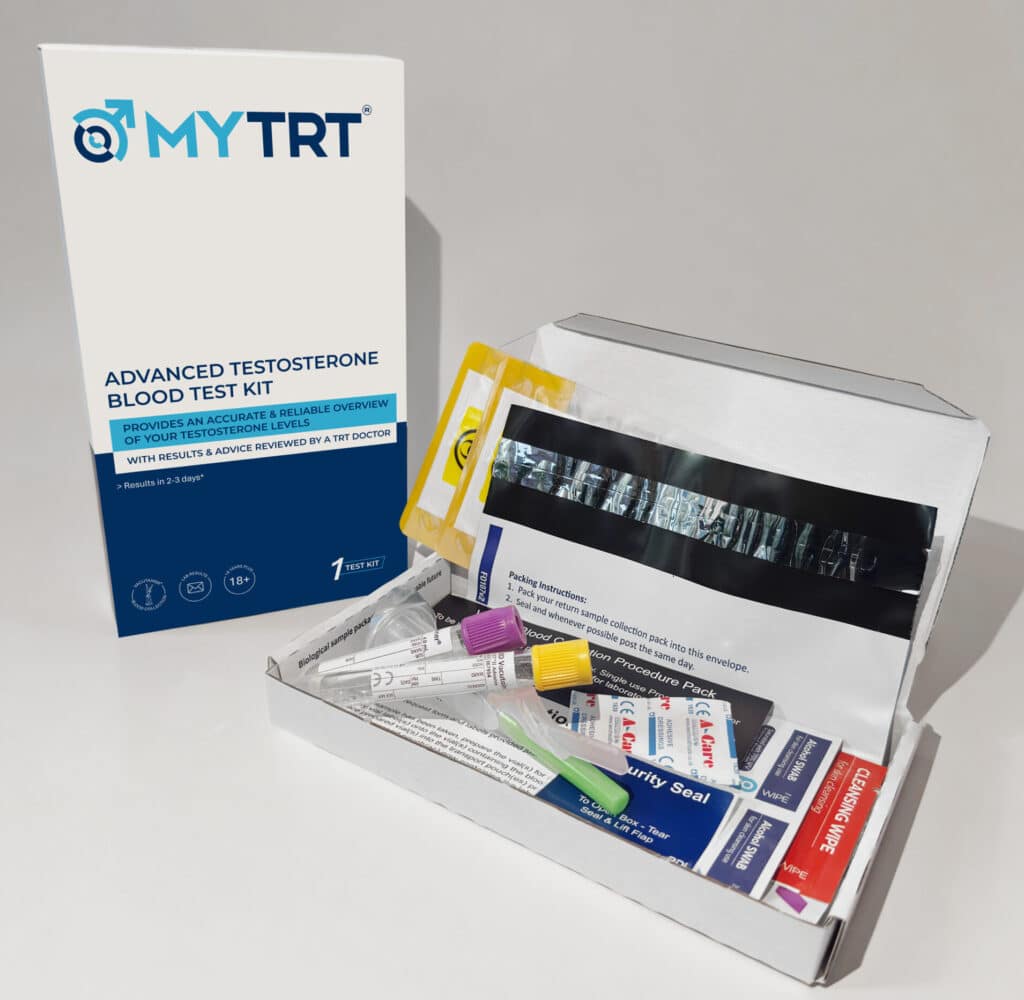
Advanced Testosterone Blood Test
Book a venous draw at a clinic £99.49
Book a venous draw at home with a nurse £109.49
 General health check
How we handle sleep and snoring at MYTRT
Sleep comes up in every initial consultation. We ask about snoring, whether anyone has observed pauses in breathing, how often you wake, whether you wake to pass urine and how sleepy you are during the day. We ask about weight history too, because it bears on both problems.
Where the answers point towards significant untreated apnoea, the sequence we favour is assessment and treatment of the breathing first, then reassessment of testosterone. Where a man is already established on CPAP and his symptoms and blood results still indicate deficiency, treatment can be considered with appropriate monitoring. Where treatment does proceed in a man with any history of disordered breathing, we monitor blood counts and we want to hear promptly if daytime sleepiness or snoring worsens, because that warrants a sleep study rather than a wait-and-see approach.
None of this is a reason to avoid getting your testosterone measured. It is a reason to have the result interpreted by someone who will ask about your sleep before deciding what it means. If you are weighing up whether treatment is appropriate at all, is TRT safe covers the wider risk picture, and what is TRT explains how treatment works.
References
- Kim SD, Cho KS. Obstructive Sleep Apnea and Testosterone Deficiency. World Journal of Men’s Health 2019;37(1):12-18. View
- Graziani A, Grande G, Ferlin A. The complex relation between obstructive sleep apnoea syndrome, hypogonadism and testosterone replacement therapy. Frontiers in Reproductive Health 2023;5:1219239. View
- Cignarelli A, Castellana M, Castellana G, et al. Effects of CPAP on Testosterone Levels in Patients With Obstructive Sleep Apnea: A Meta-Analysis Study. Frontiers in Endocrinology 2019;10:551. View
- Hackett G, Kirby M, Rees RW, et al. The British Society for Sexual Medicine Guidelines on Male Adult Testosterone Deficiency, with Statements for Practice. World Journal of Men’s Health 2023;41(3):508-537. View
- National Institute for Health and Care Excellence. Obstructive sleep apnoea/hypopnoea syndrome and obesity hypoventilation syndrome in over 16s. NICE guideline NG202. View