Medical Summary
In clinic we see countless men frustrated by vague, debilitating symptoms like chronic fatigue, low libido, and unexplained brain fog. A definitive testosterone test is the absolute cornerstone of diagnosing male hypogonadism and taking the first step toward hormonal restoration. Clinical consensus dictates that any testosterone blood test must be performed in the morning, ideally between 8 AM and 11 AM, while the patient is in a fasted state. This strict protocol accounts for the natural diurnal variation of androgens, which reliably peak early in the day before gradually declining. We rely on comprehensive blood panels measuring not just Total Testosterone, but also Sex Hormone Binding Globulin (SHBG) and Albumin to accurately calculate Free Testosterone, which is the biologically active portion available to your tissues. The British Society for Sexual Medicine (BSSM) provides clear, evidence-based parameters, defining overt deficiency as a total testosterone level below 8 nmol/L. However, levels between 8 and 12 nmol/L require serious clinical consideration and often a trial of therapy if accompanied by classic symptoms. Relying on a single biomarker is a common pitfall we actively avoid. Accurate diagnosis requires a holistic view of the entire hypothalamic-pituitary-gonadal axis, including Luteinising Hormone (LH), Follicle Stimulating Hormone (FSH), and oestrogen, to determine whether the deficiency originates in the testes or the brain.[1]
MYTRT treatment eligibility
MYTRT treats men only when they have compatible symptoms and meet both biochemical limits: total testosterone of 15 nmol/L or below, and free testosterone of 0.35 nmol/L or below.
Why You Might Need a Testosterone Blood Test
Patients often ask us when they should consider getting their hormone levels checked. The reality is that testosterone deficiency rarely presents overnight. It is typically a slow, insidious decline that gradually erodes a man’s quality of life. The symptoms are broadly categorised into physical, psychological, and sexual domains. Physically, men may notice a stubborn increase in visceral body fat, particularly around the abdomen, despite maintaining a consistent diet and exercise routine. This is often accompanied by a noticeable loss of lean muscle mass and a general feeling of physical frailty. Some men also experience gynaecomastia, which is the development of breast tissue caused by an imbalance between testosterone and oestrogen.[2]
Psychologically, the impact of low testosterone can be profound. We frequently consult with men who report a complete loss of motivation, persistent irritability, and a pervasive sense of low mood that borders on depression. Brain fog, characterised by poor concentration and memory lapses, is another hallmark symptom that drives men to seek a testosterone check. Sexually, the signs are usually more obvious. A sharp decline in libido, the absence of spontaneous morning erections, and varying degrees of erectile dysfunction are strong clinical indicators that a comprehensive hormone evaluation is necessary. If you are experiencing a combination of these symptoms, a simple testosterone test is the most logical starting point to understand what is happening inside your body.
The Physiology Behind the Test: Understanding the HPG Axis
To truly understand how to test your testosterone levels and interpret the results, you must first grasp the mechanics of the Hypothalamic-Pituitary-Gonadal (HPG) axis. This is the complex feedback loop responsible for regulating hormone production in men. The process begins in the brain, specifically in the hypothalamus, which secretes Gonadotropin-Releasing Hormone (GnRH) in a pulsatile manner. This hormone travels a short distance to the anterior pituitary gland, signalling it to release two crucial gonadotropins: Luteinising Hormone (LH) and Follicle Stimulating Hormone (FSH).
Once released into the bloodstream, LH travels to the testes where it binds to receptors on the Leydig cells, stimulating them to produce and secrete testosterone. Meanwhile, FSH acts on the Sertoli cells within the testes to support and regulate spermatogenesis (sperm production). As testosterone levels rise in the blood, the hormone exerts negative feedback on both the hypothalamus and the pituitary gland, reducing the secretion of GnRH, LH, and FSH to maintain hormonal equilibrium. When we run a testosterone blood test UK panel, we are not just looking at the final output (testosterone); we are assessing the integrity of this entire communication network. If testosterone is low but LH is high, we diagnose primary hypogonadism, indicating testicular failure. If both testosterone and LH are low, the issue lies in the brain, known as secondary hypogonadism. You can learn more about this foundational biology in our guide on what is testosterone.
How to Test Testosterone Levels: The Clinical Protocol
In clinic we see many patients who have had their hormones tested previously, only to discover the results are invalid due to poor testing protocols. Knowing how to check testosterone levels correctly is just as crucial as the test itself. The gold standard protocol requires a venous blood draw performed in the morning, strictly between 8 AM and 11 AM. Testosterone secretion follows a distinct circadian rhythm, peaking in the early morning hours and steadily declining throughout the afternoon and evening. Testing at 4 PM could yield a falsely low result, leading to an incorrect diagnosis of hypogonadism.
Fasting is another non-negotiable requirement for an accurate testosterone level test. Consuming a meal, particularly one high in carbohydrates or glucose, causes a temporary but significant suppression of circulating testosterone levels. We advise our patients to fast for at least 8 to 10 hours prior to their blood draw, consuming only water. Furthermore, we recommend avoiding strenuous, exhausting exercise the day before the test, as acute physical stress can temporarily alter hormone profiles. Adequate sleep is also vital; a single night of severe sleep deprivation can reduce morning testosterone levels by up to 15%. By controlling these variables, we ensure that the testosterone check reflects your true baseline hormonal status.
Decoding Your Results: Total vs Free Testosterone
A common misconception is that a basic testosterone test, which only measures Total Testosterone, provides a complete picture of male health. Total testosterone represents the entire volume of the hormone circulating in your bloodstream. However, approximately 98% of this testosterone is bound to proteins and is biologically inactive. The majority is tightly bound to Sex Hormone Binding Globulin (SHBG), while a smaller fraction is loosely bound to Albumin. Only the remaining 2% is “free” and available to enter cells and exert its androgenic effects on muscle, brain, and sexual tissue.
This is why a comprehensive testosterone blood test must include SHBG and Albumin. In clinic we see many men with perfectly normal Total Testosterone levels who still suffer from severe hypogonadal symptoms. Upon deeper investigation, we often find they have elevated SHBG, which effectively traps the testosterone, leaving their Free Testosterone levels critically low. Ageing, hyperthyroidism, and certain dietary factors can drive SHBG up. Conversely, men with obesity or insulin resistance may have low SHBG. We use the Vermeulen equation to accurately calculate Free Testosterone from these three variables. Understanding where you sit on this spectrum is vital, and you can compare your results against clinical benchmarks in our guide to normal testosterone levels.
Testosterone Blood Test Kit
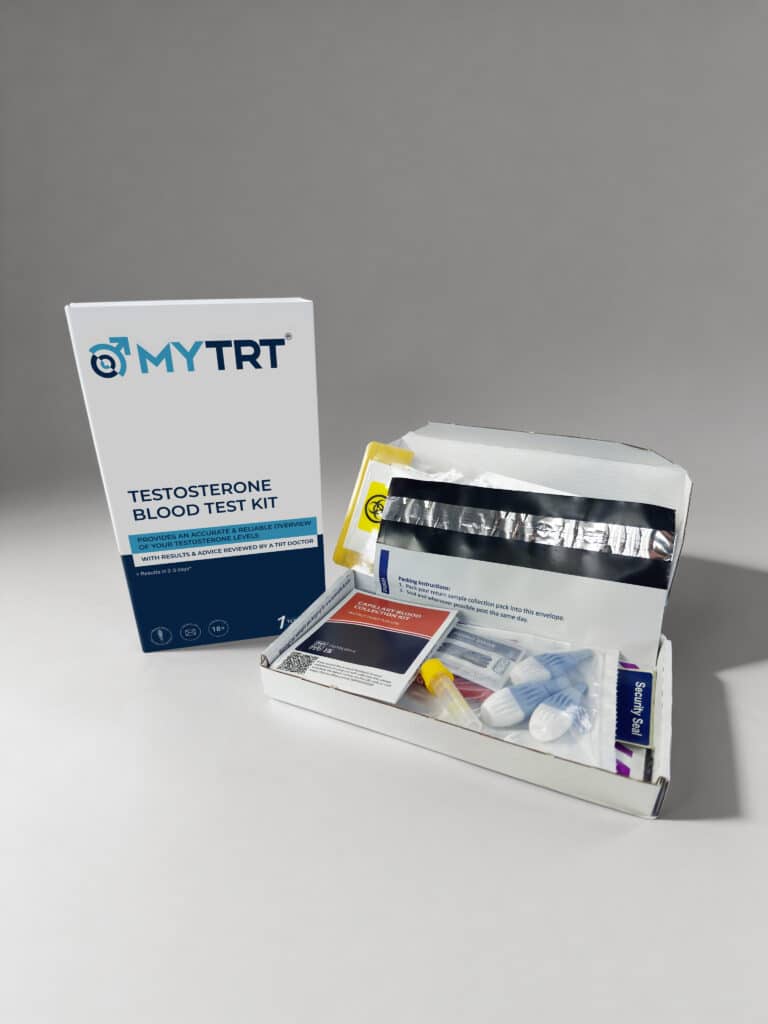
If this test showed you have low testosterone, the Advanced Testosterone Blood Test will assess your suitability for TRT.
The Role of Oestrogen, Prolactin, and Other Biomarkers
A best-in-class testosterone test UK panel extends far beyond androgens. Men naturally produce oestrogen (specifically ooestradiol) through a process called aromatisation, where the enzyme aromatase converts testosterone into oestrogen. This conversion primarily occurs in adipose (fat) tissue. While men need some oestrogen for bone density, joint health, and cognitive function, excessive levels can suppress the HPG axis, lower testosterone production, and cause side effects like water retention and gynaecomastia. Monitoring ooestradiol is a standard part of our clinical assessment.
Prolactin is another critical hormone we measure during a testosterone check. Elevated prolactin levels (hyperprolactinaemia) can severely suppress GnRH secretion from the hypothalamus, leading to secondary hypogonadism. In rare cases, exceptionally high prolactin can indicate the presence of a benign pituitary tumour known as a prolactinoma, which requires specific medical intervention. We also routinely assess Prostate Specific Antigen (PSA) and a full Full Blood Count (FBC), paying close attention to haematocrit. Testosterone therapy can stimulate red blood cell production, so establishing a baseline haematocrit is essential for patient safety before initiating any treatment protocol.[3]
Home Testosterone Test Kits: Convenience vs Accuracy
The rise of the home testosterone test kit has made hormone screening more accessible than ever, but patients often ask us if these kits are truly reliable. There are generally two types of home tests: capillary (finger-prick) and venous (phlebotomy). Finger-prick tests involve using a lancet to draw small drops of blood from the fingertip into a microtainer. While highly convenient and relatively inexpensive, they come with clinical caveats. The process of squeezing the finger can cause red blood cells to rupture (haemolysis), which can invalidate certain biomarkers. Additionally, capillary blood is a mix of venous and arterial blood, along with interstitial fluid, which can sometimes yield slightly different readings compared to a pure venous sample.
For an initial screening to get a broad idea of your levels, a finger-prick testosterone test kit can be a useful starting point. However, if the results indicate a deficiency, or if you are seeking a formal diagnosis to commence Testosterone Replacement Therapy (TRT), a venous blood draw is absolutely mandatory. Venous draws provide a larger, cleaner sample, allowing the laboratory to run a much wider array of biomarkers with superior accuracy. At MYTRT, we always advocate for venous testing when establishing a clinical baseline or monitoring ongoing therapy.
The UK NHS Pathway vs. Private Testing
Navigating the healthcare system for a testosterone blood test UK can be a frustrating experience for many men. The NHS provides an invaluable service, but its approach to male hypogonadism is often constrained by strict local trust guidelines and budget limitations. When you request a test through your GP, they will typically only measure Total Testosterone. If that single reading comes back within the local laboratory’s reference range (which can sometimes extend as low as 6 nmol/L depending on the region), you may be told your levels are “normal,” regardless of how severe your symptoms are. You can read more about this specific journey in our detailed breakdown of the testosterone test NHS pathway.
In contrast, private specialist clinics adhere strictly to the guidelines set out by the British Society for Sexual Medicine (BSSM) and the European Association of Urology (EAU). These guidelines recognise that symptoms of deficiency can manifest at much higher thresholds. The BSSM states that a Total Testosterone level below 12 nmol/L, or a Free Testosterone level below 0.225 nmol/L, warrants a six-month trial of TRT if the patient is symptomatic. Private testing also guarantees a comprehensive panel, ensuring SHBG, LH, FSH, and ooestradiol are measured from the outset, dramatically reducing the time it takes to reach an accurate diagnosis and begin treatment.
What Happens If Your Testosterone Check Shows Low Levels?
Receiving a low result on a testosterone level test can be daunting, but it is also the first step toward regaining your vitality. In clinic we see the profound relief patients experience when they finally have a biological explanation for their symptoms. If your first test indicates low testosterone, clinical guidelines require a second confirmatory test, performed at least two weeks later, under the same strict fasting and morning conditions. This rules out any transient anomalies caused by acute stress, illness, or poor sleep.
Once a diagnosis of hypogonadism is confirmed, the next step is a detailed consultation with a hormone specialist. We will discuss your medical history, fertility aspirations, and lifestyle factors. Treatment options typically involve Testosterone Replacement Therapy (TRT), administered via micro-dosed subcutaneous injections or topical gels, designed to mimic the body’s natural physiological rhythm. Alongside medical intervention, we strongly emphasise lifestyle optimisation. Improving sleep hygiene, correcting nutritional deficiencies (such as Vitamin D and Zinc), managing psychological stress, and engaging in resistance training can all synergistically enhance the effectiveness of your treatment protocol.
The Impact of Ageing on Testosterone Levels
A frequent topic of discussion during a testosterone check consultation is the natural ageing process. Unlike women, who experience a rapid and definitive cessation of hormone production during the menopause, men undergo a much more gradual decline, sometimes referred to as the andropause or late-onset hypogonadism. From the age of 30, a man’s total testosterone levels decline by approximately 1% to 2% per year. While this might sound insignificant, over a couple of decades, it represents a substantial reduction in total androgenic output.
Compounding this issue is the fact that SHBG levels tend to increase as men age. This means that not only is the body producing less total testosterone, but a higher percentage of what is produced is being bound and rendered inactive. Consequently, the decline in Free Testosterone is often much steeper than the decline in Total Testosterone. This is precisely why older men presenting with symptoms of fatigue and low libido must insist on a comprehensive panel rather than a basic total testosterone check. Age should not be a barrier to feeling energetic and healthy.
References
[1] Hackett G, Kirby M, Wylie K, et al. British Society for Sexual Medicine Guidelines on Adult Testosterone Deficiency, with Statements for UK Practice. J Sex Med. 2017;14(12):1504-1523. View
[2] Bhasin S, Brito JP, Cunningham GR, et al. Testosterone Therapy in Men With Hypogonadism: An Endocrine Society Clinical Practice Guideline. J Clin Endocrinol Metab. 2018;103(5):1715-1744. View
[3] National Institute for Health and Care Excellence (NICE). Clinical Knowledge Summaries: Hypogonadism – male. Available at: View